SAND IS CHARACTERIZED BY ITS ABILITY TO FLOW (LE SABLE SE CARACTÉRISE PAR SA CAPACITÉ À S'ÉCOULER)
With Fanny Testas
Sand, glass, ceramic, electronics, steel, aluminium, mineralogical elements and documents Collaborators: Sophie Argentin (ceramics), Simon Denise (metal), Camille Jamain (acoustic treatment), Clémentine Léon and Gautier Scerra of Service Local (graphic design), Stéphane Pelletier of Atelier Gamil (glass), Edouard Sufrin (electronics)
Produced by La Station - Gare des Mines.
Supported by the 2024 Fonds Régional pour les Talents Émergents (FoRTE) of the Île-de-France Region, the Centre National de la Musique and Adagp
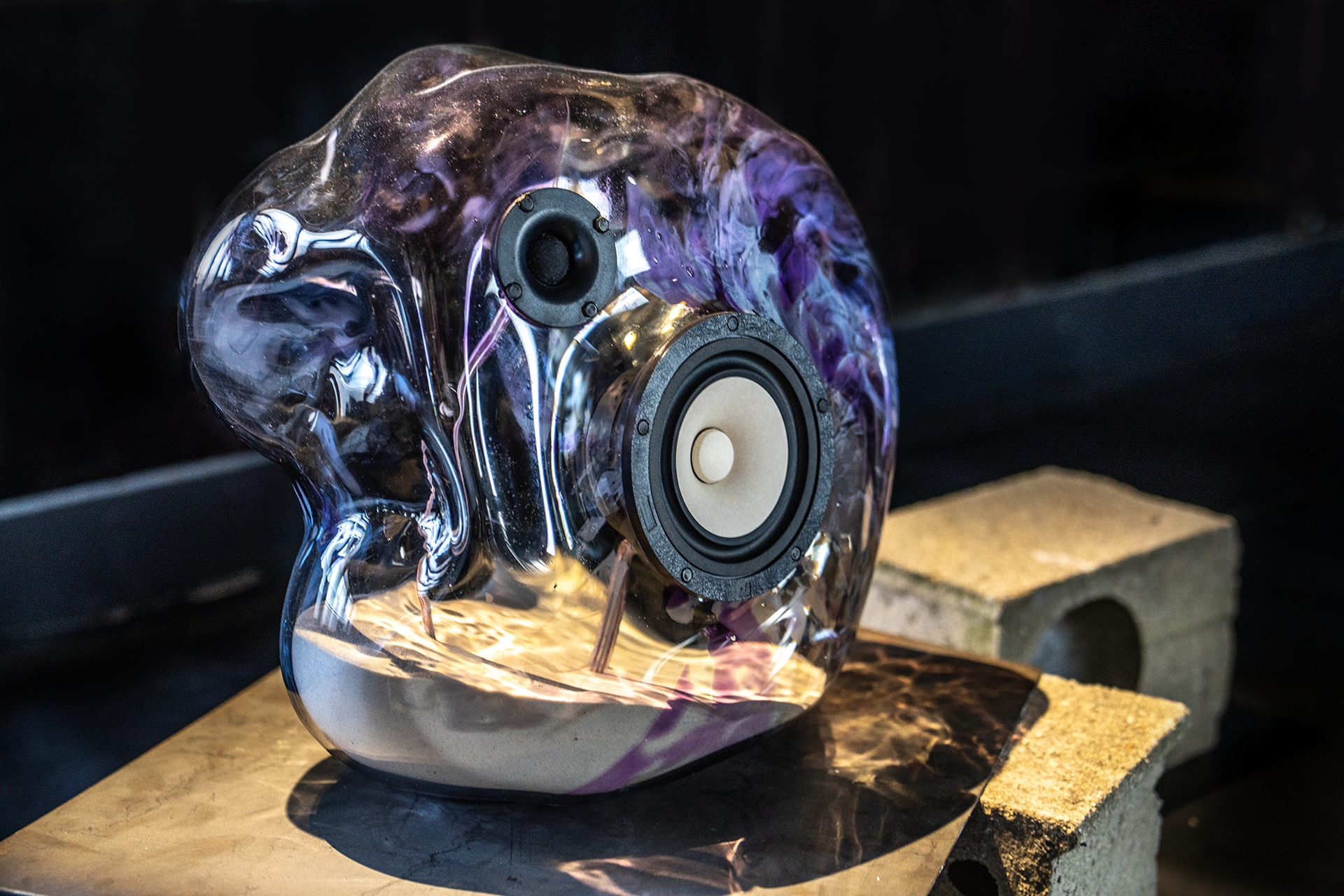
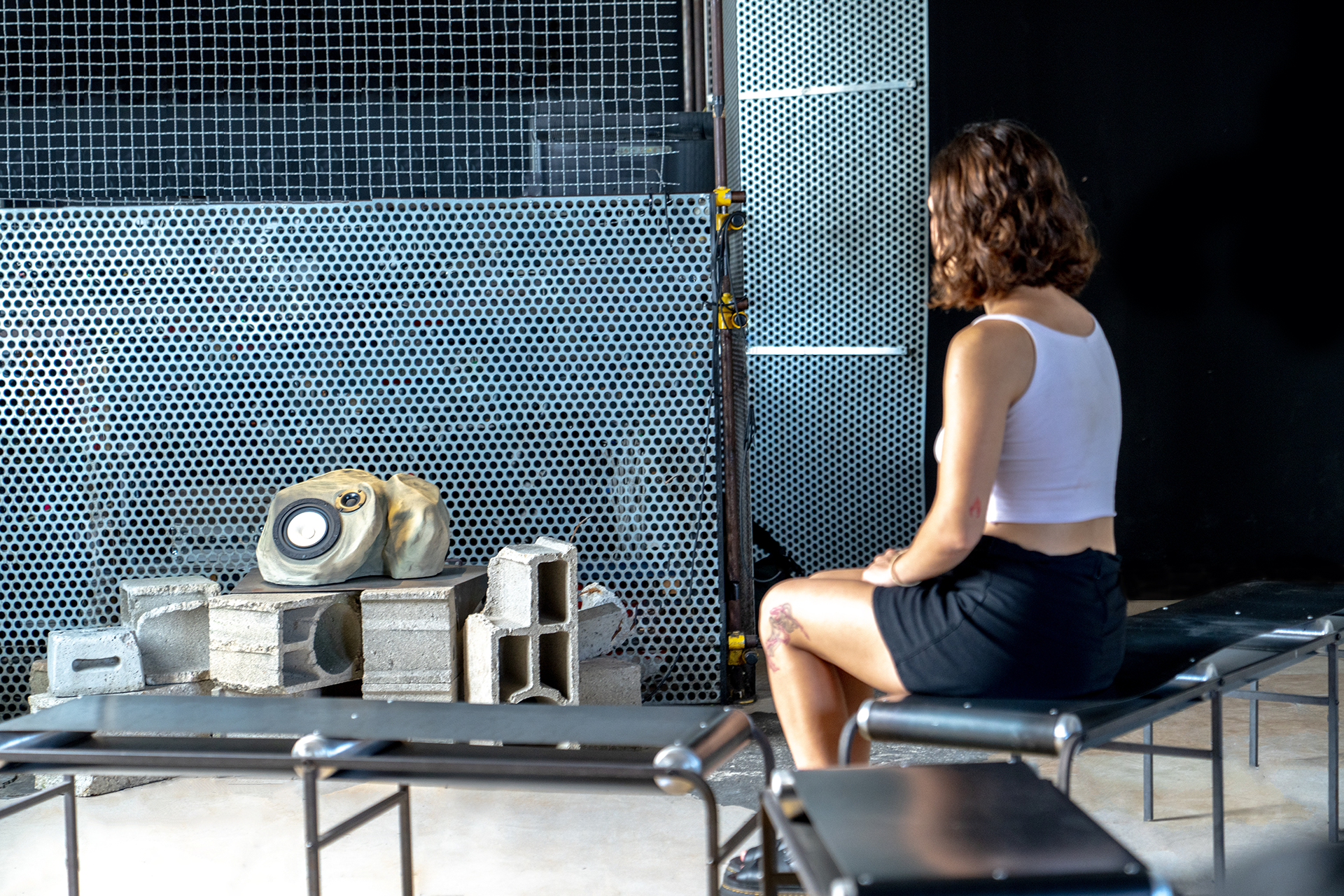
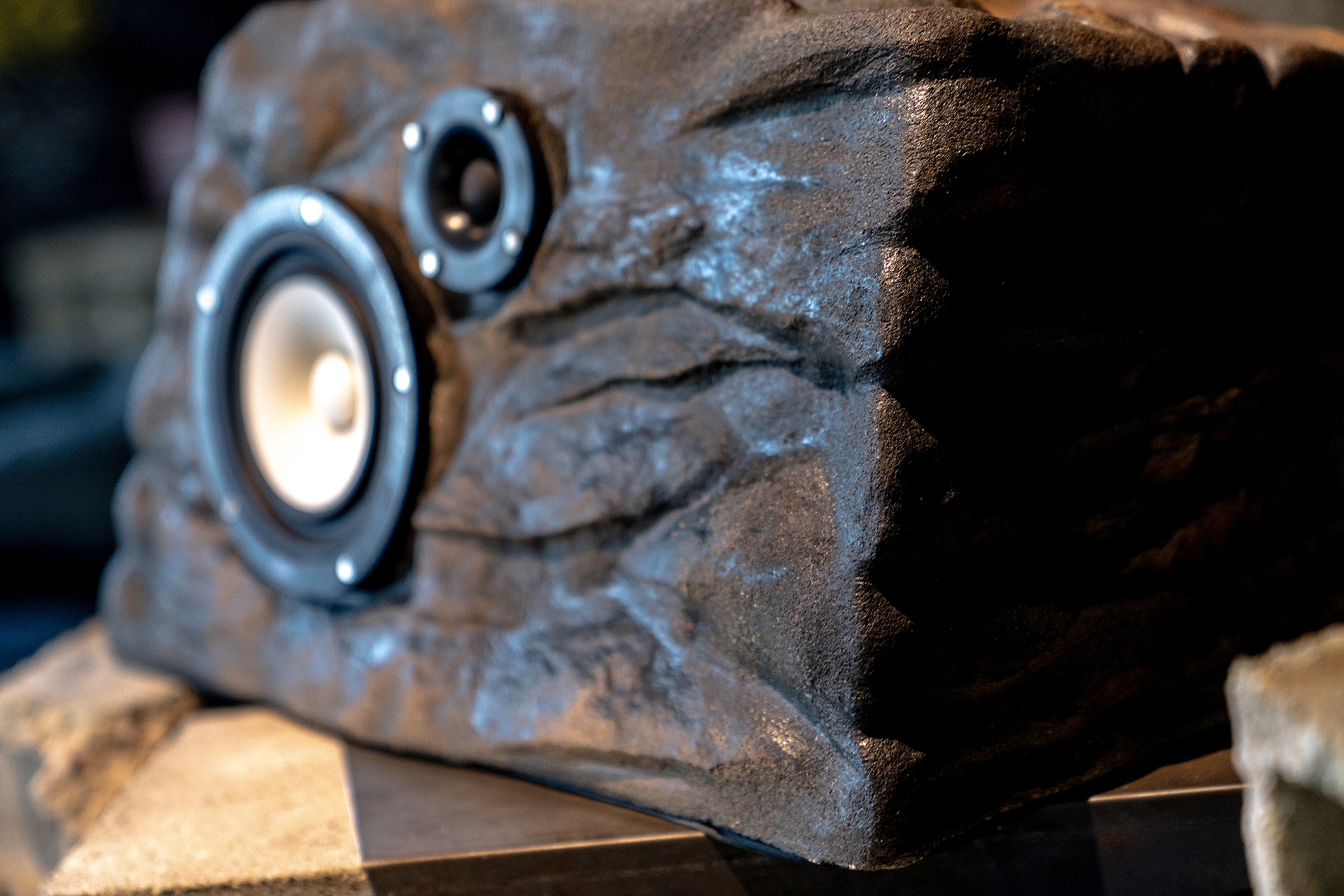
The installation sable se caractérise par sa capacité à s'écouler follows the journey of a grain of sand. Between documentary investigation and poetic drift, this tale of the infinitely small begins in the Fontainebleau forest, which has one of the finest sands in the world. Inspired by the geological and industrial processes that transform sand, the installation creates a space for listening or musical play, staged by a set of tool-sculptures. Glass, ceramic and concrete speakers dialogue with a set of listening benches inspired by sand conveyors, as well as archipelago tables that present the elements and findings from the investigation. Here, each element tries both to give a voice to this mineral with many faces, as a way for it to tell its own story, and to raise in the background the question of managing a common good that has become an object of speculation. While it has transformed the world as well as our ways of living and communicating, its intensive exploitation is causing it to become scarce and prompts us to rethink our futures.
The project Derniers Souffles consists of three installations, shown below: Ressac, Écueils and Archipel (in production). The project follows a series of workshops with young non-verbal autistic people in medical-educational institutes. During sound naps, the young people reached states of relaxation that had previously been difficult for them to attain, thanks to the use of low frequencies and white noise. Intrigued by their effects, we began to take an interest in the psychoacoustic and suggestive potential of white noise and in the ways of producing it. We therefore sought to generate noises with particular grains, which led us to analog circuits based on old germanium (Ge) and silicon (Si) components. We started hunting through flea markets, dismantling equipment and salvaging old military and industrial stock to find, test and compare these famous components, now obsolete. This (in)quest also immersed us in their history and conditions of production, and in the extraction of the resources needed to refine and assemble them, bringing to the surface ecological and social issues tied to our techno-industrial history and changing how we read this sound. The famous white noise, so appreciated for its ability to relax us, then paradoxically appears as the artificial noise of technological excess.
DERNIERS SOUFFLES: ARCHIPEL
With Edouard Sufrin
steel, electronic circuit, speaker, speakers.
Benefited from the Sodavi grant of the Seine-Saint-Denis department
and from the support of the European project TEKHNE, with GMEA and Qo²
Residency at GMEM, 2023.
Residency at GMEA, 2025
Festival Oscillation, IMAL, 2026
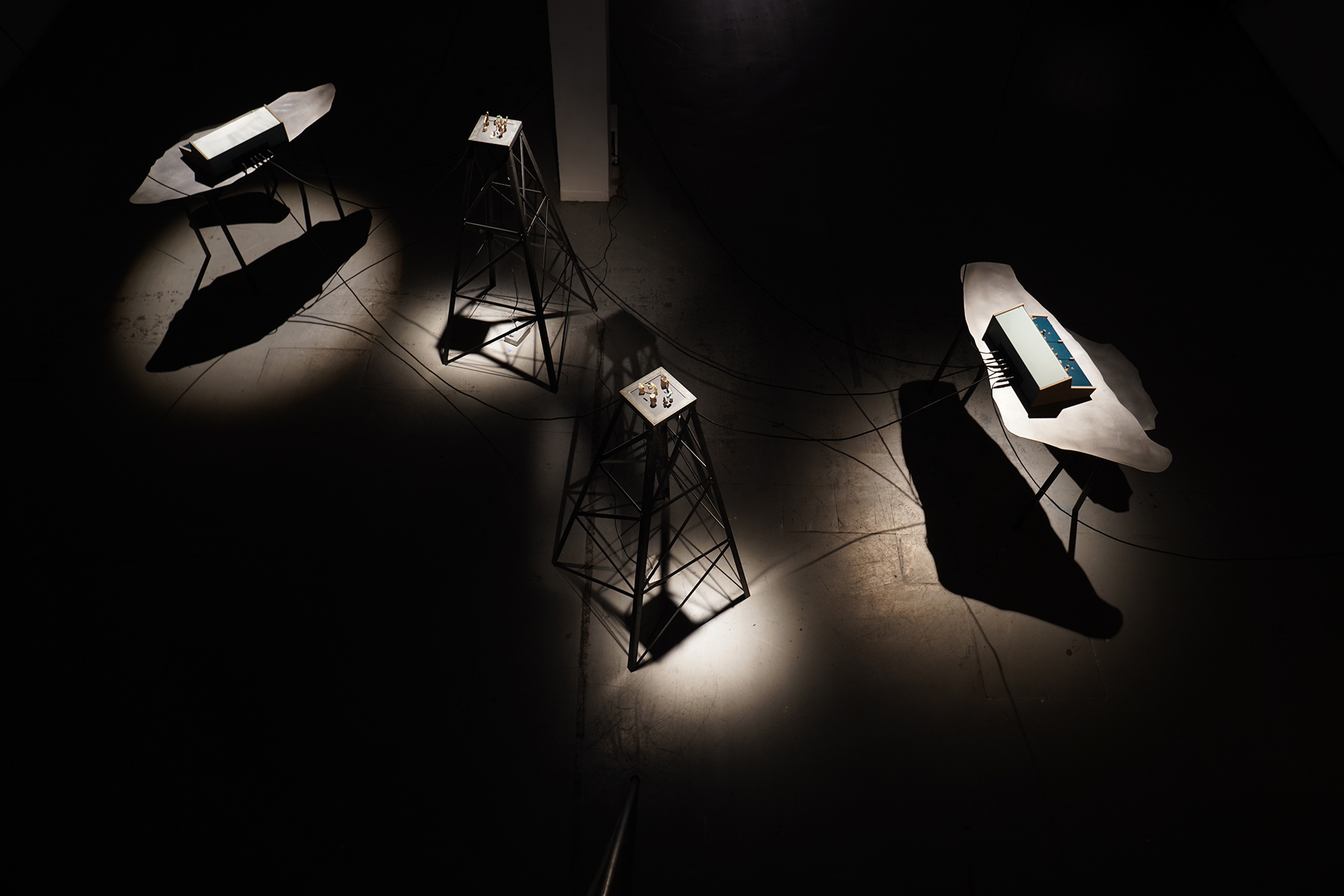
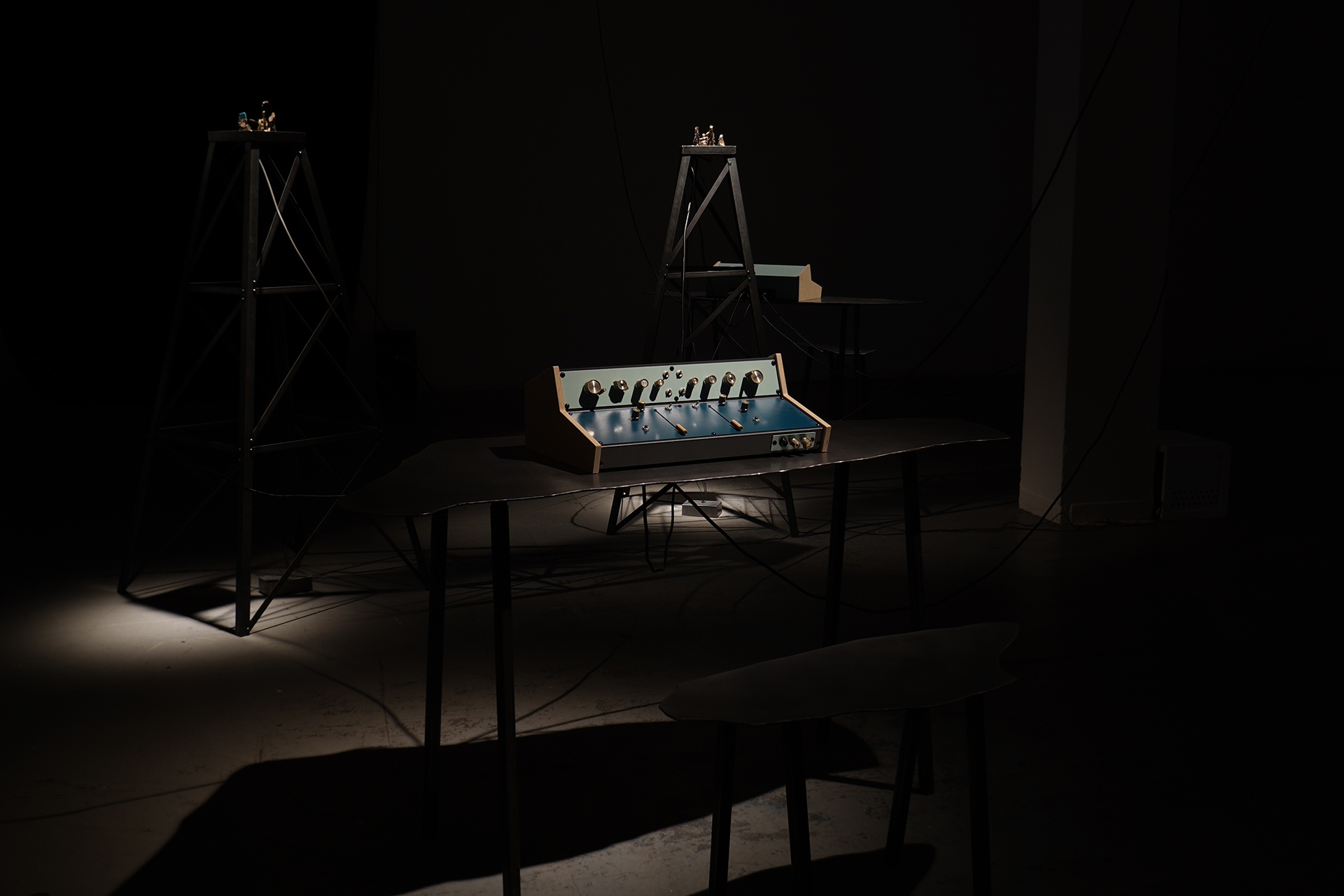
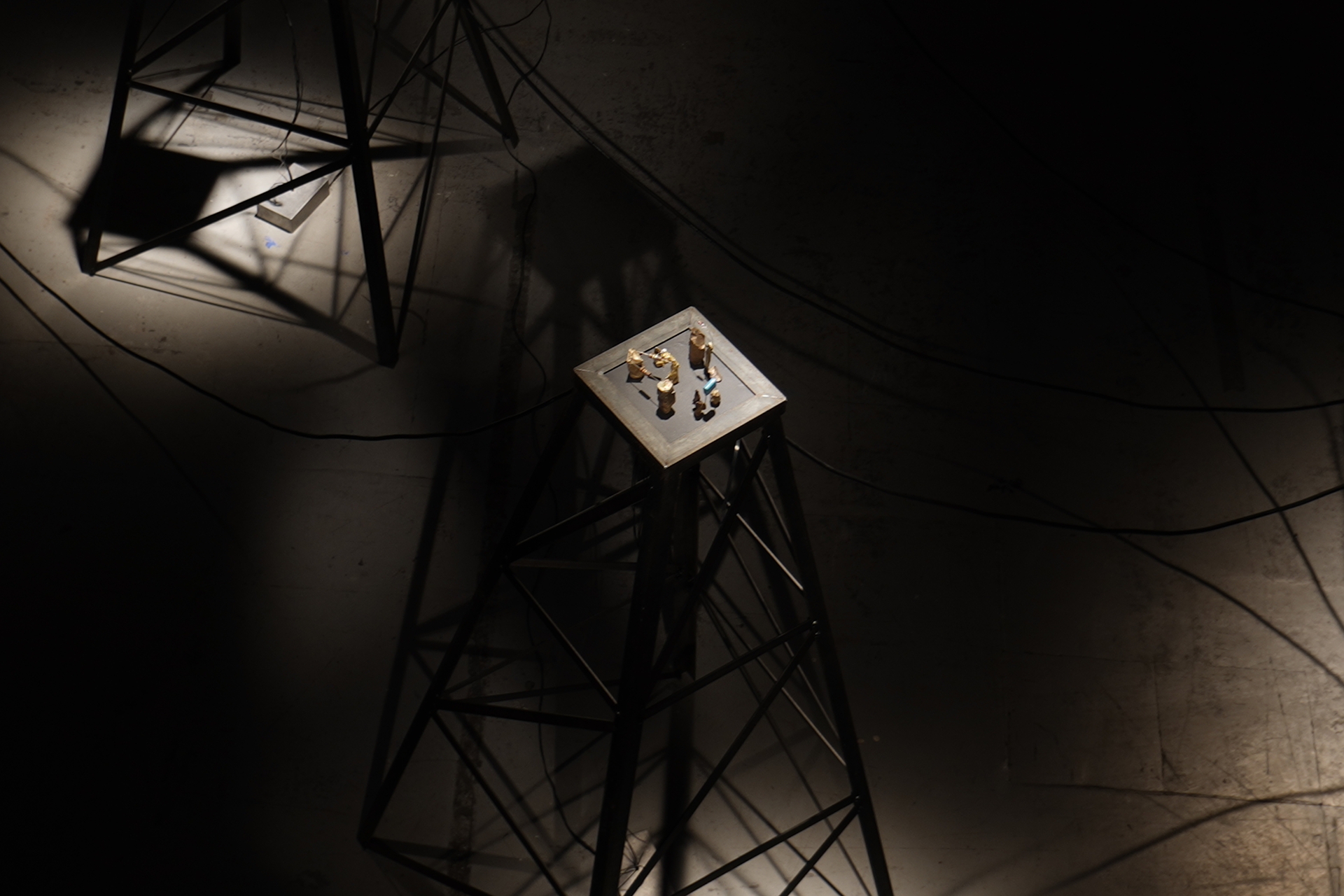
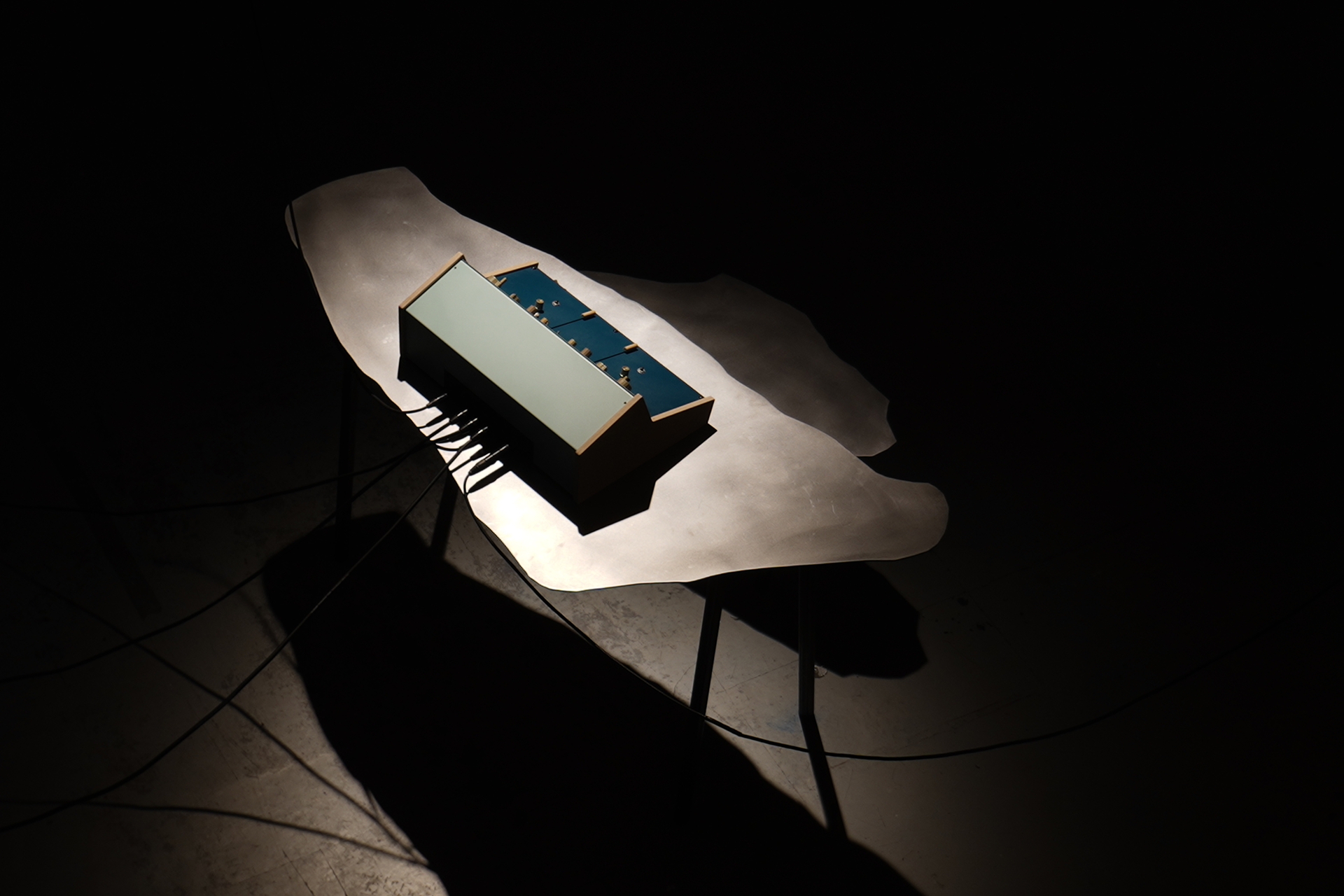
Archipel plays with the musicality of the breath of diodes and transistors through a sound installation that can be played by two people; an attempt to create a language for speaking to oneself and to others without words. Drawing on the figure of the archipelago as a form of relation, the installation links instrument-sculptures through cables and through a shared experience. Activated during performances, concerts and lectures, it becomes a medium for collective musical and theoretical expression. The installation consists of two central pylons. Each houses an electronic sculpture, which is a noise generator. The sound is emitted by old germanium and silicon diodes and transistors. These are connected to two sound machines that act as a two-way mixing console, where one can play with volume, stereo distribution and resonance filters, using the chips of the Polivoks, a vintage Russian synthesizer renowned
for its wild character.
DERNIERS SOUFFLES: RESSAC (UNDERTOW)
With Edouard Sufrin
Electronic components, brass, industrial housings, compression drivers.
Ressac is made up of three industrial housings turned into reliquaries for electronic circuits. They bring obsolete electronic components back to life (germanium diodes and silicon transistors) in order to study their acoustic particularities. Connected to compression drivers, each circuit, shaped in brass, amplifies the breath of a component, transistor or diode, to emit a sound close to white noise. This breath is then modulated to create amplitude variations and simulate the surf of the sea. The sound comes from a phenomenon called the "avalanche effect". Inside the mineral with semiconductor properties, electrons accelerate until they strike atoms, which then release other electrons in a cascade, generating a breath. Close to white noise, these sounds fill the space and activate imaginary landscapes, simulacra of natural and marine environments whose electrical grain can betray the artificial origin of the amplified frequencies. An avalanche with torrential sonorities, an allegory of the climate disruptions that threaten our techno-industrial world. And what if the last sound we hear were the gentle surf of a sea swallowing us up?
DERNIERS SOUFFLES: ÉCUEILS (REEFS)
With Edouard Sufrin
Electronic components, brass, concrete blocks, wireless (TSF) headset.
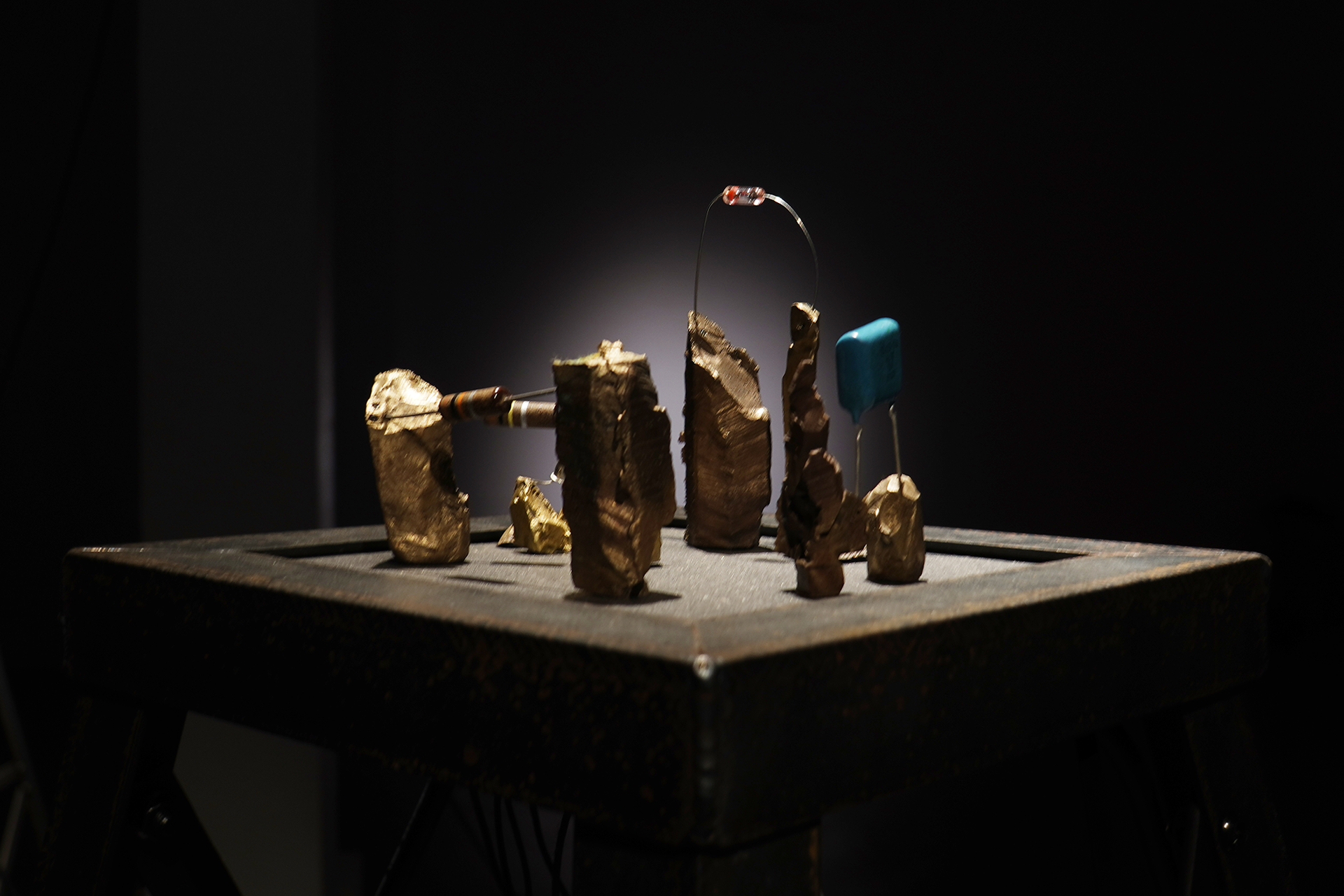
The Écueils, those rocks that jut dangerously out of the sea, are materialized by a set of concrete blocks on which rest two fragile circuits shaped in brass, whose components' breath produces a sound close to white noise. Embedded in the blocks are two dimmers. They allow the volume of the circuit to be modulated in each ear of the military radio headset. Here, the aim is to offer visitors a listening experience of the potential psychoacoustic properties of these almost-white noises. While they can clearly evoke the sound of a fountain, rain or the sea, they can also give rise to other, more subjective apparitions such as voices or melodies. It is probably because they are made up of all audible frequencies that our cognitive mechanisms become more susceptible to these sound illusions known as pareidolia. Our brain tries to recognize identifiable forms in abstract sounds, built from our imaginaries, personal references and cultural constructions.
DÉRIVES (DRIFTS)
With Edouard Sufrin
Philosophical excerpts, junction box, stainless steel, electronic circuit, speaker, battery.
Outre-sons, Les instants chavirés, 2024
Le nom du monde est forêt, CNEAI, 2022.
Galerie d'art de la ville de Créteil, 2020.
CNEAI collection, 2022.
Photos:
Dérives exhibited at Les instants chavirés for Outre-sons.
4: Stainless steel version made for the CNEAI collection in 2022.
Dérives is a series of ceramic boxes aged with cobalt and manganese oxides, ores that are also present in our technological tools. Inside, a diffusion device is concealed that picks a sound sample from a sample library at a random time and in a random order. Electrical sounds then escape, along with the voices of researchers, thinkers and critical perspectives. The sounds of the different boxes mix, and the points of view answer one another. Not without irony, chance becomes the creator of multiple meanings.
A unique version of this installation was made in metal for the CNEAI collection.
LES LUCIOLES (THE FIREFLIES)
with Edouard Sufrin
Autonomous electronic modules,
sound and light.
Outre-sons, Les instants chavirés, 2024
La Gaîté Lyrique, 2018.
Concerts dispersés,
Centre d'Art Contemporain
de Cajarc, 2017
Nuit Noire, 2016.
Nuit Noire, 2015.
These fireflies are a metaphor
for people who preserve their popular
culture by resisting
political pressure. Even if this resistance seems
to be only a faint glimmer in the
night, like that of a tiny firefly, it instils the idea that we will constantly
succeed in escaping the watchtowers of our era.
The installation Les lucioles is inspired by the essay
Survivance des lucioles by
Georges Didi-Huberman.
Analysing a letter written by
Pasolini to his friend Franco Farolfi
in 1941, he draws an analogy between
ecological disturbances, the disappearance of fireflies and the
political troubles that were unsettling Italy at the time.
CURIOSITÉS MINÉRALES (MINERAL CURIOSITIES)
Electronic components, brass, minerals, electronic circuits, speakers.
Project created for the Mallapixels, Val-de-Marne.
2020.
Curiosités minérales is a series of three glass bell jars bringing together three generations of electronic components. Carbon resistors, germanium diodes and silicon transistors have marked the history of technological development, whether in the military or civilian, industrial or artisanal sphere. Here, they are associated with the minerals and elements that give them their properties. Unusual curiosities that are nonetheless everyday, surrounding us in excess. Our current phones and computers each contain several billion transistors that we can no longer observe with the naked eye, unlike the first generations of components. While this contributes to the obsolescence of our technologies, it above all deepens our ignorance of how they work inside.
These bell jars are paired with a sound device broadcasting stories that invite us to delve into the history of this miniaturization, from our electronic chips to the stardust of which they, like us, are made.
MAINS D'ŒUVRES (WORKFORCE)
Electronic components, brass, speakers, graphic material, tools.
See-U, Brussels
2022.
"Probably somewhat crushed by the difficulty, and perhaps by the fear of telling themselves where they stood, they rummaged through their machines to ask themselves where they would stand."
2084, video by Chris Marker, 9m46s, 1984
Taking Chris Marker's film 2084 as its basis, the installation Mains d'œuvres questions the future of the worker in the age of all-digital. The installation draws a cyber-portrait of the future by making voices drawn from the internet (philosophers, journalists, politicians, citizens and media) speak to one another randomly and anachronistically. This sound database, a sort of archive of the present, examines here the concerns raised by 2084: work, the advent of technologies, the future of workers.
The exhibition space is transformed into a workshop-laboratory, where time seems to have stood still and where human presence is missing. It is ultimately the works, still in the process of being made, that autonomously tell us the memories of possible futures, those of the year 2084. On the workbench of Mains d'œuvres, the meeting of traditional jewelry-making techniques and printed circuits materializes in a circuit-sculpture that questions the future of our modes of production.
FIREWALL
with Edouard Sufrin
Modified Juniper SSG firewall,
autonomous power supply,
mini smoke machine.
DOC Paris, 2018.
This firewall seems to lead an autonomous existence, subject to
phantom connections that cause malfunctions, leading it to overheat,
smoke, then restart.
Once immersed in the augmented-reality part of the exhibition, using
virtual reality glasses, the visitor receives a profusion of spam and pop-ups
offering numerous warnings about the health of their computer or other
ways to make easy money.
EN CAS DE NÉCESSITÉ (IN CASE OF NEED)
with Edouard Sufrin
Repurposed manual trigger
box, electronic device.
Do you live in fear? Thanks to these
boxes, you can
recreate the sounds of
any kind of siren and
alarm. A product that will answer any of your problems!

MACHINES À HABITER (MACHINES FOR LIVING)
Paper and cardboard models,
build-it-yourself kits.
Sound book, interviews,
video archives, articles.
Project supported by the Espace
Jean-Roger Caussimon of
Tremblay-en-France during
the 2019/2020 year.
EP7, 2018.
"Machine for living" ("machine à habiter") was a term used by Le Corbusier for the housing blocks he built. Yet in 1965, one of these machines for living was built in Montfermeil, a machine that would mark an entire era since it became the symbol of a
ghetto and was demolished in 1994. All these constructions are urban monuments, both common and personal. Strong elements of History, they marked those who knew them and help us understand how these territories were built. These places are proof of the perpetual movement of the city. This project pays tribute to them.
Inspired by the products sold in the souvenir shops of major tourist sites, Machines à habiter is a collection of build-it-yourself urban monument kits. The whole is accompanied by a body of archives as well as a sound book gathering historical research and the testimonies of people who
"lived" the architecture of these places.